
Your usual ride ends with less battery left than it used to. Is the pack wearing out, or did a cold morning and a headwind simply ask more of it?
How long does an e-bike battery last? You might mean how far it will take you on a charge, how much capacity it retains as it ages, or what the warranty covers.
The quick answer: An e-bike battery ages through both use and time, even while sitting unused. Its useful life depends on its condition, remaining capacity, and whether it still covers your regular rides. Bosch’s battery guidance says an exact service life cannot be predicted. Compare similar rides, investigate persistent problems, and replace a battery when its condition or remaining useful range warrants it.
| Meaning | What it measures | The useful question |
|---|---|---|
| Range per charge | Distance on one charge under particular riding conditions. | Will it cover my route with a reserve? |
| Battery lifespan | Changes in capacity and condition over time and use. | Is performance still reliable and useful? |
| Warranty | Coverage under the manufacturer’s stated terms. | Does this issue qualify for a claim? |
On this page
- How long does an e-bike battery last in years?
- Battery range and lifespan are different measurements
- What e-bike battery charge cycles mean
- My range has dropped: what should I check?
- When to replace an e-bike battery or get it assessed
- How to look after your e-bike battery
- Plan a replacement before buying one
- E-bike battery lifespan FAQs
- Make the decision around your next ride
How long does an e-bike battery last in years?
An e-bike battery can remain useful for years, but there is no reliable calendar-based replacement rule. Neither a warranty period nor a cycle rating tells you the service life of your particular pack.
Two people can buy the same bike on the same day and have very different experiences. One commutes year-round and regularly uses most of the charge. The other rides on weekends, then parks the bike for months. Their cycle counts will differ, but both batteries continue aging.
That is why a blanket “replace it after three years” rule is unhelpful. Your charging habits, storage conditions, and usage history matter as much as age. Heat and prolonged storage at very high or low charge levels can shorten service life, according to Bosch.
Does your battery still reliably cover the rides you need to make?
Suppose your normal outing is a short trip to the shops. Some gradual capacity loss may make little practical difference. If you rely on the bike for a long commute with no charging at work, the same loss could remove the reserve you need for a detour or difficult weather.
Keep the purchase date, battery model, and service history, along with a record of how performance has changed. These give a dealer useful context.
Battery range and lifespan are different measurements
Range is the distance you can ride on one charge. Lifespan concerns how the battery performs over months and years. Your electric bike battery life can look worse on a demanding ride even when its long-term condition has barely changed.
State of charge means how full the battery is now. State of health describes its remaining capacity compared with when it was new. Specialized explains these measures separately.
Imagine a battery that originally supplied 500 watt-hours of usable energy but now supplies 400. It has 80% of that original usable capacity. The display can still show 100% charged: the battery is full, but it holds less than before.
Those numbers are illustrative. The capacity printed on a pack and the energy available for riding are not always identical, because manufacturers distinguish rated capacity from usable capacity and system reserves.
How far should one charge take you?
Use your model’s range guidance as a starting point, then compare it with your route. Trek’s range explanation identifies assistance level, load, wind, temperature, and terrain as factors that affect how far you can travel.
Estimated distance = usable battery energy ÷ energy used per mile or kilometer.
For illustration, 400 usable Wh divided by an assumed 20 Wh per mile gives 20 miles before setting aside a reserve. At an assumed 10 Wh per mile, the same energy gives 40 miles. These are example consumption rates, not typical-range claims.
A retailer’s “up to” distance is therefore a poor benchmark for diagnosing your own battery. A repeatable journey on your own bike is more useful.
What e-bike battery charge cycles mean
Plugging in the charger does not automatically use up one whole cycle.
An equivalent full cycle adds together partial amounts until they equal a full battery’s worth of energy. Trek illustrates this with five 20% top-ups, which together count as one full cycle.
Suppose you use half a charge and replenish it, then use and replenish a quarter on each of two later rides:
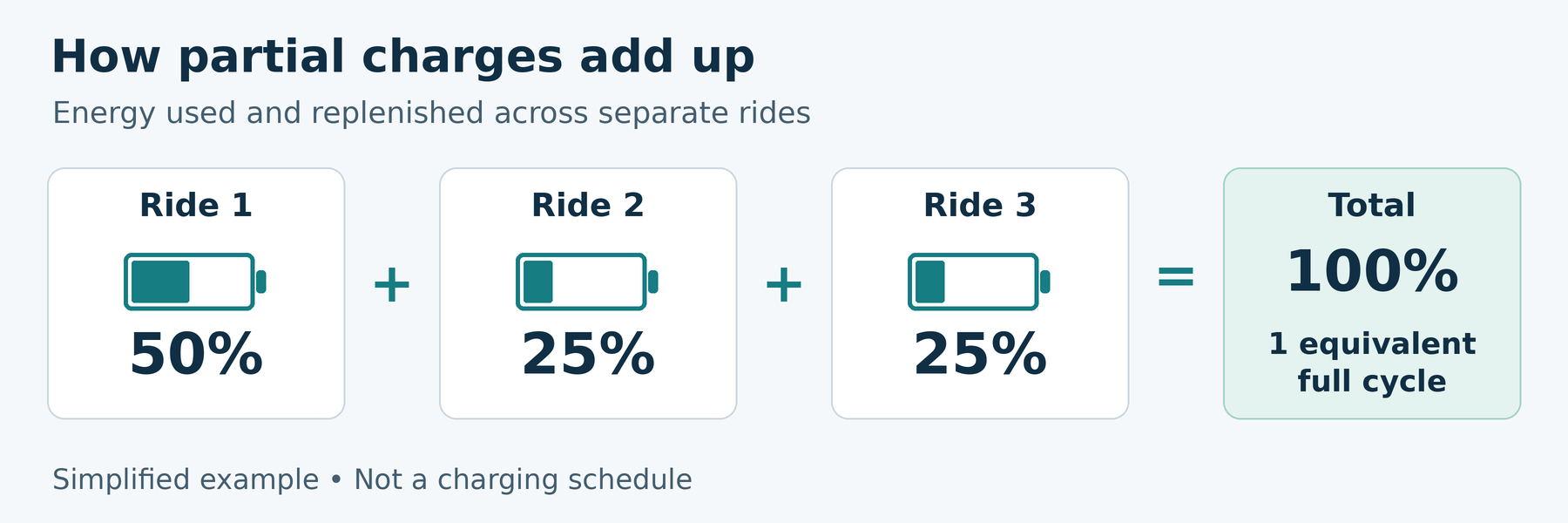
Three top-ups can add up to one equivalent full cycle: 50% + 25% + 25% = 100%. This is an illustration, not a charging schedule.
The battery management system determines the cycle count your bike reports, so its calculation may be more nuanced than this example. You do not need to deliberately run the battery empty to complete a cycle.
A cycle rating needs an endpoint
“1,000 cycles” is incomplete information unless you know what capacity remains at that point and how the battery was tested.
For example, Shimano’s BT-E8010-A specification lists 1,000 cycles with more than 60% capacity remaining as a reference figure. That is a specification for that battery, not a universal expectation for every e-bike pack or a promise that it suddenly stops working on cycle 1,001.
Before comparing two cycle claims, look for the retained-capacity figure, test conditions, and whether the statement describes a specification or warranty.
A cycle-to-year calculation that divides a cycle rating by your annual charging estimate leaves out calendar aging. A low cycle count on an old, poorly stored battery does not establish that it is nearly new.
My range has dropped: what should I check?
Start with what changed between rides. A disappointing distance on one windy day deserves a different response from repeated shutdowns on a familiar route.
Check the riding conditions and the bike before assuming the battery is worn out. Trek and Bosch both identify factors that can change range from one ride to the next.
| What changed? | Possible explanation | Useful next check |
|---|---|---|
| Colder weather | Cold can reduce battery performance. | Compare in similar, milder conditions. Follow the manual’s temperature limits. |
| More hills or headwind | The route now demands more assistance. | Compare the same route in similar wind, at a similar pace. |
| Higher assist or extra cargo | The motor is doing more work. | Match the assistance setting and load before comparing. |
| Low tire pressure or drag | The bike may take more effort to move. | Use appropriate tire pressures. Have rubbing brakes or other drag assessed. |
| Persistent loss on similar rides | Capacity aging or a system issue is possible. | Bring a ride log to a qualified dealer and ask about a capacity assessment. |
| Charging faults or unexpected cutouts | A battery, charger, connection, or other system fault may be involved. | Follow the manual’s error guidance and arrange service. Do not repeatedly reproduce a cutout. |
Safety exception: Do not take another comparison ride with a damaged battery, abnormal heat, swelling, leaking, an unusual smell, or odd noises. See the stop-use signs below.
Copy this simple ride log
Choose a familiar route that leaves a comfortable reserve. Keep your assistance setting, load, and tire pressures reasonably consistent, and compare rides in similar weather. Two or three comparable trips can give you a better starting point than one unusually good or bad ride.
Copy the table into your notes and fill in one column after each trip. Use whichever distance and temperature units you normally ride with.
| Record after each ride | Ride 1 | Ride 2 | Ride 3 |
|---|---|---|---|
| Date / route | |||
| Distance (miles or km) | |||
| Temperature / wind | |||
| Assistance setting / pace | |||
| Rider and cargo load | |||
| Tire pressures | |||
| Starting charge (%) | |||
| Finishing charge (%) | |||
| Errors or unusual behavior |
For example, finishing a 12-mile route at 60% after starting at 90% means the display fell by 30 percentage points. If a later ride uses 45 points, check the conditions before blaming the battery. Those figures are examples, not test results.
Do not turn that percentage change into an exact capacity measurement. Display estimates and riding demands vary. The log is most useful for spotting a persistent pattern and giving a technician something concrete to investigate.
Record error messages exactly, including when they occur. “Power cuts out on the steep hill after ten minutes” is more useful than “the battery seems bad.” There is no need to keep reproducing a fault to make the log more complete.
When to replace an e-bike battery or get it assessed
A professional assessment can help you decide whether the battery needs replacement.
Book an assessment for persistent performance problems
Arrange a check if comparable rides consistently use much more charge, the bike repeatedly loses power unexpectedly, or charging problems continue despite following the manual. These symptoms justify investigation; they do not, by themselves, prove that the battery is the faulty component.
Ask a qualified dealer to check the battery and the related bike and charging system. Where the system supports it, request a capacity measurement and an explanation of any fault codes. Bosch, for example, says its dealers can measure available capacity with a CapacityTester.
Useful questions to ask:
- What did the assessment find?
- Is the problem capacity loss or another fault?
- Is the battery suitable for continued use?
- What approved replacement options are available?
A battery with 80% capacity may still meet a short-trip rider’s needs. A damaged pack needs attention regardless of its reported percentage.
Stop using and charging a battery with warning signs
The U.S. Fire Administration identifies unusual odor, excessive heat, a change in shape or color, leaking, and odd noises as reasons to stop using a lithium-ion battery. Swelling or serious visible damage should not be treated as ordinary aging.
Stop riding and charging. Ask the manufacturer or a qualified service provider how to handle the battery safely. Do not open the pack, bypass its protection system, or try to revive individual cells.
If it is smoking or burning, get away and call emergency services. Do not pick up a smoking or dangerously hot battery to carry it outside. New York City’s lithium-ion battery safety guidance prioritizes leaving the area and calling 911.
How to look after your e-bike battery
Your battery and charger manual takes priority over a generic charging routine.
Charge for the ride you are planning
Use the supplied charger, or a replacement specifically approved for your system. Charge while you are awake and present, follow the manufacturer’s instructions, and disconnect when charging is complete. These are core recommendations in the CPSC’s micromobility charging guidance.
Partial top-ups are compatible with modern lithium-ion systems when used as directed. You don't have to wait for the battery to empty, and each brief charging session isn't a full cycle.
If tomorrow’s trip needs a full charge, follow your manual and prepare for that ride. Charging for use and leaving a bike parked for a season are different situations. Avoid turning a storage recommendation into a rule that leaves you short of power on the road.
Let the battery reach a suitable temperature
Health Canada advises bringing larger battery systems to room temperature and not charging them below 0°C (32°F). A battery brought in from a freezing garage needs time to warm naturally; do not try to speed this up with direct heat.
Check your model’s charging limits after a hot ride too. Use a dry charging location away from combustible materials and exit routes. Inspect the pack before charging, even if the charger’s status light looks normal.
Make a plan for winter or other long breaks
For prolonged storage, Bosch recommends a charge level of 30% to 60%. Health Canada’s general guidance for larger lithium-ion systems is about 50%, checked every three months and topped up if needed. Your own manual may set a different checking interval or range.
Choose an appropriate dry location protected from temperature extremes. Set a calendar reminder to check the charge so you don't forget the battery until spring. Do not leave it connected to a charger for the entire storage period.
For cleaning, follow the manufacturer’s external-care instructions. Bosch recommends a damp cloth and warns against direct water jets or pressure washing. Keep the housing closed and leave internal work to the approved service route.
Plan a replacement before buying one
Start with the warranty and a diagnosis. Then compare an approved replacement with the condition and usefulness of the whole bike.
Read the battery warranty separately
Your frame’s warranty and your battery’s coverage may be different. A warranty also has conditions; it is not a predicted failure date.
For example, Specialized’s Canadian warranty page lists Turbo battery coverage as two years or 300 charge cycles, whichever comes first. That does not mean a battery is finished after two years or that normal wear is automatically covered.
Find the policy that applies to your model, country, and purchase date. Check any capacity-retention terms, required proof of purchase, exclusions, and claim procedure. Bring the receipt and assessment results when asking the dealer about coverage.
Get the correct pack and the full installed price
An online listing with the same voltage or a similar-looking connector is not enough. Trek warns that a component can physically fit without being designed to work with the bike’s electrical and software systems.
Ask for the approved part number, confirmation of compatibility, availability, and the complete cost. Include any installation, required accessories, taxes, and recycling charges in the comparison. If the original pack has been discontinued, ask the manufacturer about supported alternatives before ordering something that merely looks close.
There is no useful universal replacement price without knowing the battery. A written quote for your exact system is a better planning tool than an old online price range.
Would a new battery or a new bike serve you better?
A sound bike that fits well and still does the job is a strong candidate for an approved replacement battery. The calculation changes if it also needs major repairs, replacement parts are unavailable, or its range and carrying capacity no longer suit your life.
Write down two totals: the installed battery plus necessary repairs, and the cost of a suitable replacement bike. Compare the useful range, fit, service support, parts availability, and warranty coverage each option gives you.
Base the decision on the assessment, the quotes, and your regular rides. Battery age alone does not justify buying a new bike, and a cheap pack is poor value if compatibility is uncertain.
Arrange proper recycling
Keep e-bike batteries out of household trash and general recycling.
In Canada, use the e-mobility battery recycling locator and select the e-mobility filter. These packs require designated collection points; they do not belong in ordinary household-battery collection boxes.
In the United States, Hungry for Batteries lists participating brands and collection locations. Confirm eligibility before visiting. If your brand is not covered, ask its manufacturer or your local hazardous-waste service about the appropriate route.
For a damaged, defective, or recalled battery, contact the collection program for handling instructions before transporting or shipping it.
E-bike battery lifespan FAQs
Why does my battery show 100% but take me fewer miles?
The charge percentage shows how full the battery is, not how much of its original capacity remains. Aging is one explanation, but first compare weather, assistance, load, and route. A full battery on a harder ride can cover less distance without a new fault.
Does charging after every ride wear it out faster?
Counting plug-ins alone will not tell you. Partial top-ups add together toward equivalent full cycles. Follow the manufacturer’s charging routine and distinguish preparing for another ride from storing the bike for weeks or months.
Can I use a battery after its warranty expires?
The end of a warranty is not an expiry date. Base continued use on condition, reliable operation, the manufacturer’s instructions, and any assessment findings. Check the manufacturer for recalls or service notices if you have concerns about your pack.
Will a bigger battery solve a range problem?
A higher-capacity battery may extend range if the manufacturer approves it for your exact system. It will not diagnose an underlying charging or bike fault. Check the cause and compatibility before paying for an upgrade.
Make the decision around your next ride
If your battery still reliably covers your normal route with a sensible reserve, a little capacity loss may be something to monitor. Take the ride log to a qualified dealer if the change persists under similar conditions. Stop using the battery if there are warning signs.
You can browse eBikeSavvy’s riding and ownership guides for related topics.