
The ECOLEAP K2 combines a 750W peak motor, full suspension, three speed settings, and a chainless drivetrain in a compact electric dirt bike designed for young riders. But is it the right choice for your child?
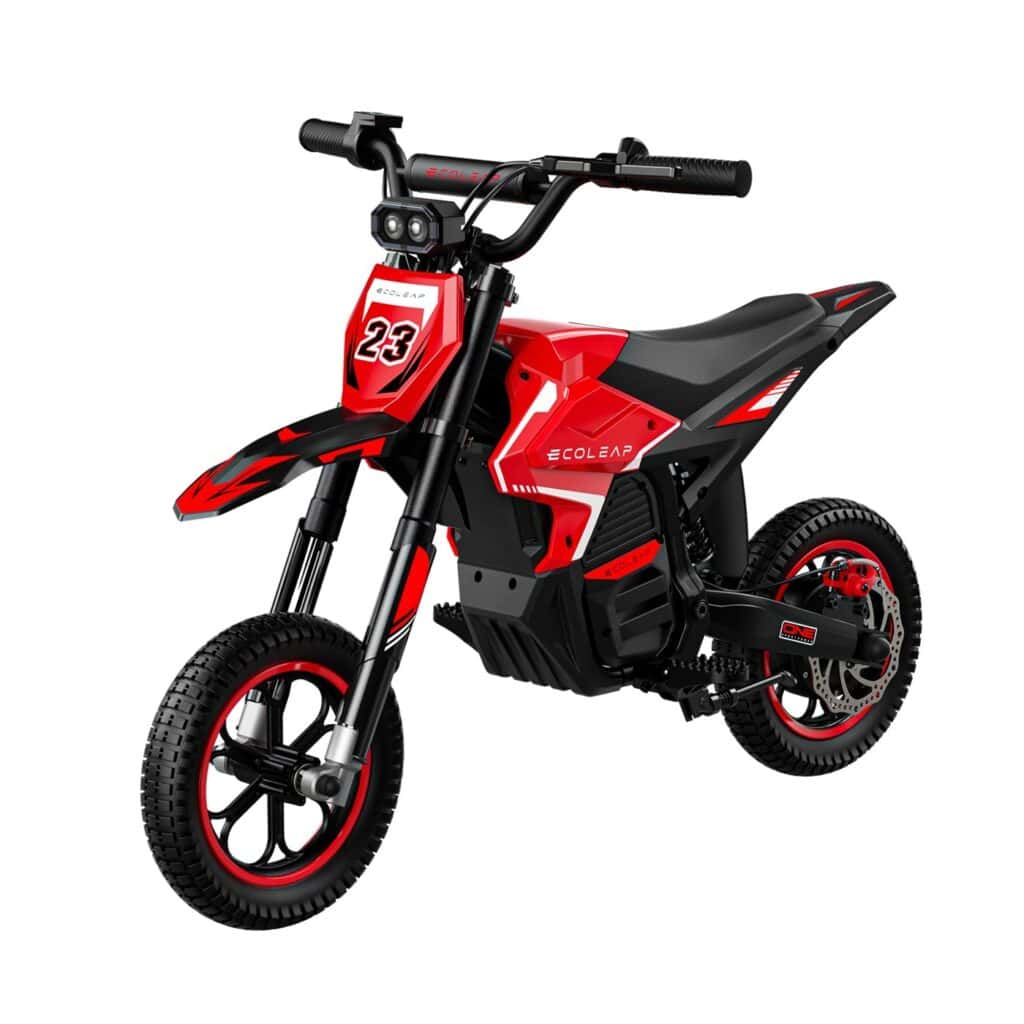
ECOLEAP K2 in red. Manufacturer image: ECOLEAP.
Finding the right electric dirt bike for a child isn’t simply about choosing the fastest model or the one with the biggest motor. Parents need something that’s appropriately sized, manageable for a developing rider, durable enough for outdoor adventures, and equipped with features that make learning easier.
That’s where the ECOLEAP K2 Kids Electric Dirt Bike becomes interesting.
Designed primarily for children ages 4–8, the K2 offers a surprisingly substantial package. It features a 36V brushless motor, three selectable speed modes topping out at 20 mph, front and rear suspension, 12-inch pneumatic tires, and a chainless hub-motor drivetrain.
Its advertised range of up to 18 miles also suggests there’s enough battery capacity for more than a few short laps around the yard.
What stands out most, however, is the combination of genuine dirt-bike-style hardware and a relatively compact frame. Unlike basic electric ride-on toys, the K2 has a steel chassis, suspension at both ends, and a mechanical disc brake.
That doesn’t automatically make it the best electric dirt bike for every child. A 20 mph top speed is significant for a young rider, and the K2’s single rear brake deserves careful consideration.
In this ECOLEAP K2 review, we’ll examine its motor, battery, suspension, safety features, construction, and overall value to help you decide whether it belongs on your family’s shopping list.
Interested in the ECOLEAP K2?
Compare current pricing, available colors, shipping details, and customer feedback before purchasing.
Affiliate disclosure: eBikeSavvy may earn a commission from qualifying purchases if this link is configured with its Amazon Associates tracking ID.
ECOLEAP K2 Review: Quick Verdict
The ECOLEAP K2 looks like a promising option for families seeking a compact electric dirt bike with more capability than a conventional children’s ride-on toy.
Its strongest selling points are the three speed modes, full suspension, relatively low-maintenance chainless drivetrain, and 36V lithium battery.
The lowest setting, 10 mph, gives developing riders a less aggressive starting point than the bike’s full 20 mph capability, though even 10 mph can be too fast for an absolute beginner.
The full suspension and pneumatic tires are particularly appealing for children riding across grass, gravel, and relatively smooth dirt trails. These features should help reduce the harshness of bumps compared with rigid-frame ride-on toys.
However, there are trade-offs.
At approximately 42 pounds, the K2 isn’t especially light for a small child. It uses a single rear mechanical disc brake rather than separate front and rear brakes. While the manufacturer advertises up to 18 miles of range, real-world endurance depends heavily on terrain, speed, rider weight, and riding conditions.
Best for: Children with established balance skills who are ready to develop throttle and braking control under close adult supervision.
Not ideal for: Children who have never learned to balance on two wheels, families wanting a very low-speed ride-on toy, or riders seeking a more advanced electric motocross bike.
ECOLEAP K2 Specifications
| Specification | ECOLEAP K2 |
| Motor | 400W continuous brushless hub motor |
| Peak power | 750W advertised; some manufacturer materials say 850W |
| Top speed | Up to 20 mph |
| Speed modes | 10 / 15 / 20 mph |
| Battery | 36V 7.8Ah lithium-ion |
| Battery capacity | 280.8Wh |
| Advertised range | Up to 18 miles |
| Charging time | Approximately 5–6 hours |
| Front suspension | Inverted hydraulic / oil-spring fork |
| Rear suspension | Spring shock absorber |
| Brakes | Rear mechanical disc brake |
| Tires | 12 × 2.75-inch pneumatic |
| Frame | Carbon steel |
| Drivetrain | Chainless brushless hub motor |
| Seat height | 20.67 inches |
| Bike weight | 41.89 pounds |
| Maximum load | 176 pounds |
| Recommended age | 4–8 years |
| Recommended rider height | Approximately 37–56 inches* |
| Lighting | Dual LED headlight |
| Display | LED speed, battery, and mode indicator |
| Water resistance | IP54 |
| Battery certification | UL 2271, manufacturer-reported |
| Electrical system certification | UL 2272, manufacturer-reported |
ECOLEAP’s published height guidance varies between product-page versions. Verify current fit guidance before purchasing. Specifications are manufacturer-reported, not independently measured.
Design and Build Quality: More Than a Basic Ride-On Toy
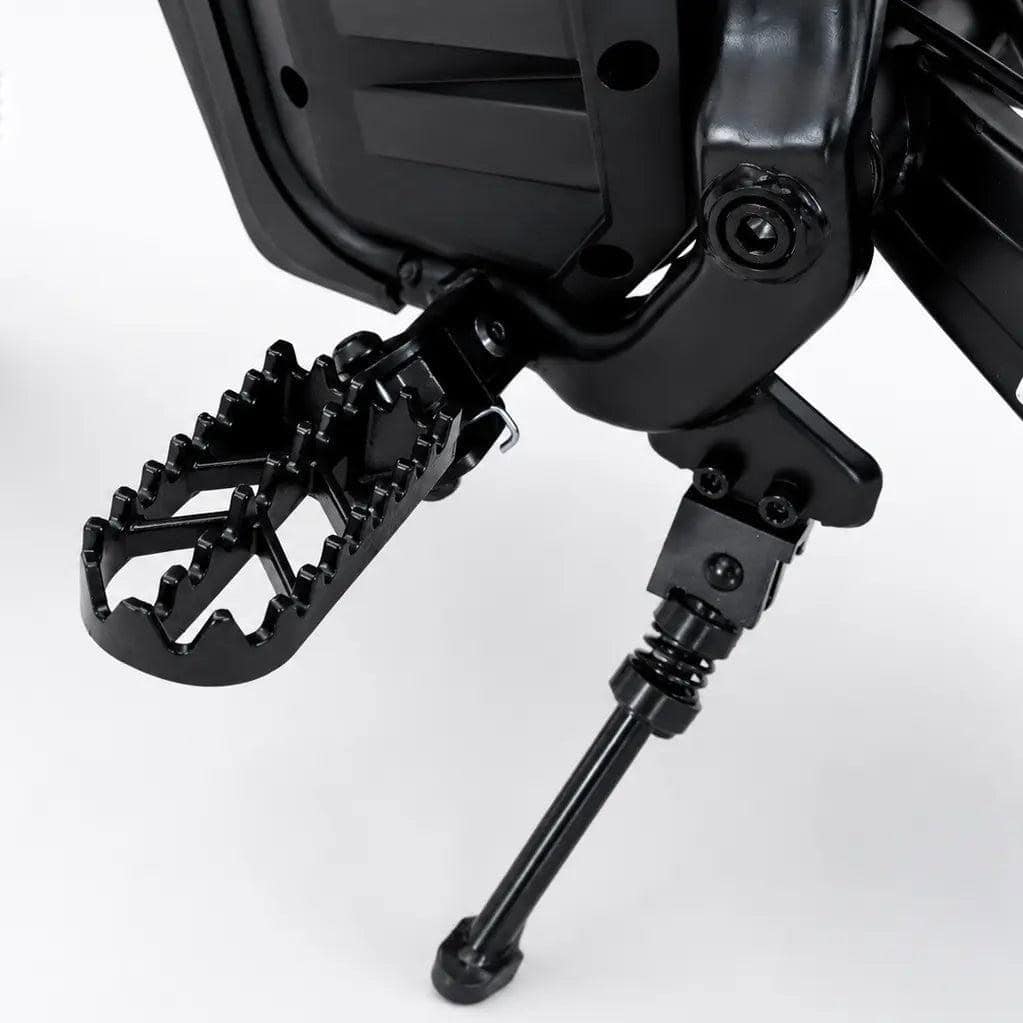
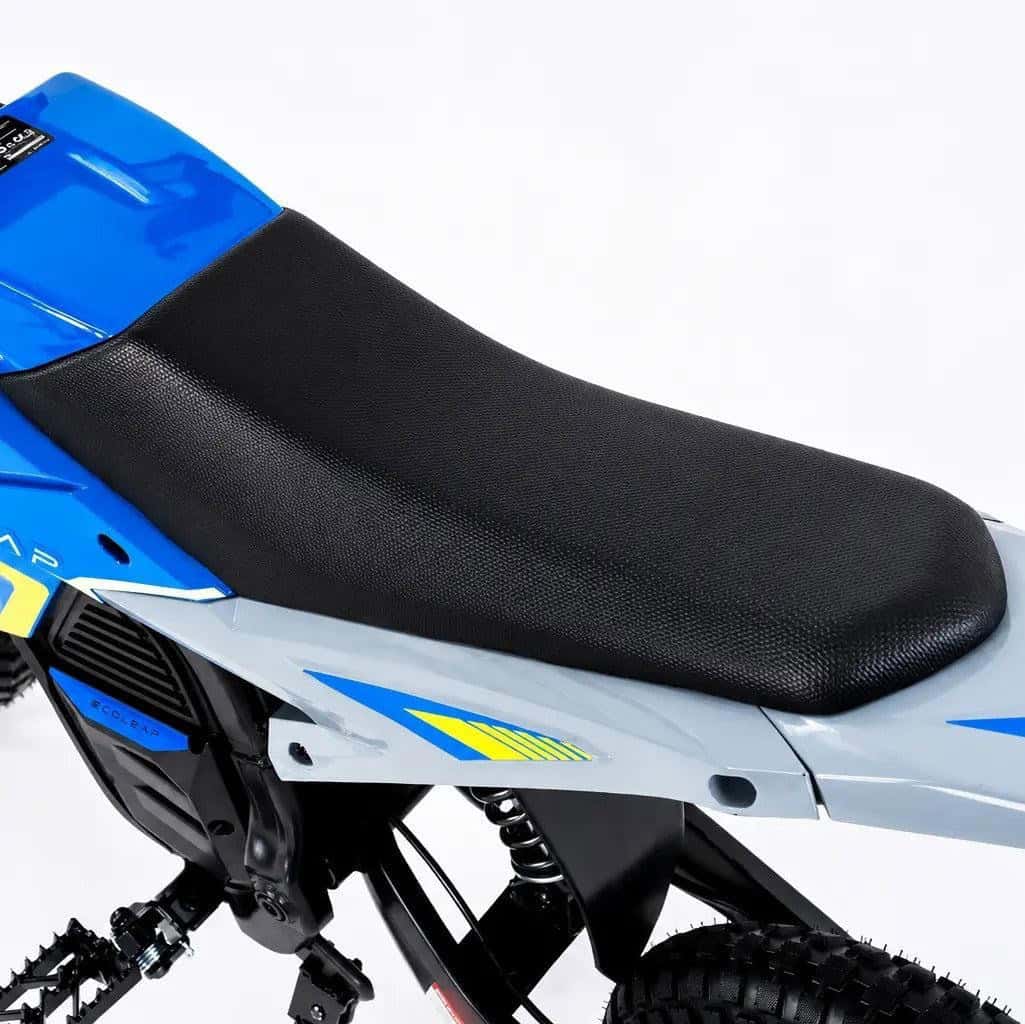
Seat and footrest details. Manufacturer images: ECOLEAP.
One of the K2’s most appealing characteristics is its dirt-bike-inspired design.
Rather than resembling a conventional children’s bicycle with an attached motor, the K2 uses a motorcycle-style frame, a long padded seat, footrests, and wide off-road tires.
Overall, it looks more like a scaled-down electric pit bike than a typical toy-store ride-on.
Carbon Steel Frame
The K2 uses a carbon steel frame, a sensible choice for a relatively affordable electric dirt bike.
Steel is generally durable, repairable, and well suited to products that may experience occasional knocks or falls.
The trade-off is weight.
At 41.89 pounds, the K2 is substantial for its intended riders. That weight may contribute to a planted feel, but it also makes the bike harder for a smaller child to push, pick up, or reposition after a fall.
Parents should consider the child’s physical strength and confidence, not just whether they can reach the ground.
Seat Height and Rider Fit
The K2’s seat sits approximately 20.67 inches from the ground.
That’s relatively accessible compared with larger youth electric dirt bikes, but seat height alone doesn’t determine whether a child will fit comfortably.
Leg length, reach to the handlebars, and ability to operate the brake lever all matter.
Before purchasing, I would pay particular attention to whether the intended rider can comfortably place their feet on the ground and operate the controls without stretching.
A child who can barely touch the ground may struggle to stabilize a 42-pound bike when stopping.
Wheels and Finishing Details
ECOLEAP uses integrated, non-spoke wheels paired with 12-inch pneumatic tires.
This eliminates traditional spoke-tension maintenance and gives the bike a clean appearance.
The K2 also includes a padded seat, wide footrests, fenders, and a kickstand.
These are practical features that make the bike feel more like a purpose-built recreational vehicle than a disposable electric toy.
Motor and Acceleration: Enough Power for Young Riders?
The ECOLEAP K2 uses a 36V brushless hub motor rated at 400W continuous output.
Manufacturer materials disagree on peak output, listing either 750W or 850W. Both figures describe short-duration peak power rather than continuous output.
For a children’s electric dirt bike, the sustained 400W rating is arguably more useful than the peak number.
The K2 is intended for recreational riding rather than high-performance motocross use.
Chainless Hub Motor
One of the K2’s most distinctive features is its chainless drivetrain.
Instead of transmitting motor power through a chain and sprocket, the motor drives the wheel directly.
This design offers several practical advantages.
It eliminates the need to lubricate, adjust, or replace a drive chain, and it can’t derail during a ride.
It also removes one potential pinch point associated with exposed chain-drive systems.
For parents who prefer spending time riding rather than maintaining a small motorcycle, that’s a meaningful benefit.
However, a hub motor isn’t automatically superior in every situation. It adds weight at the wheel, and servicing the motor may require specialized replacement parts.
Acceleration and Throttle Control
The K2’s motor should provide useful acceleration for recreational riding, particularly on firm surfaces.
However, without instrumented testing, it’s impossible to establish how quickly the bike accelerates or how smoothly the throttle responds.
That distinction matters because a young rider’s confidence depends on predictable power delivery, not just motor wattage.
Parents should test the throttle response in a safe, open area before allowing a child to ride independently.
Three Speed Modes: One of the K2’s Most Useful Features
Manufacturer-advertised speed settings
These are advertised speed limits, not independently verified measurements.
The K2 offers three selectable speed settings:
- 10 mph: The lowest setting, intended for initial throttle and braking practice.
- 15 mph: A middle setting for riders who have developed more confidence and control.
- 20 mph: The maximum setting, suitable only for appropriately skilled riders in controlled conditions.
This adjustability is one of the K2’s strongest selling points.
A child doesn’t necessarily need access to the bike’s full performance immediately. Instead, parents can introduce its capabilities gradually.
That said, the lowest setting still reaches 10 mph, which can cause serious injuries in a fall.
I would not treat the presence of a beginner mode as proof that the K2 is suitable for every four-year-old.
It’s also worth confirming whether an adult can lock or restrict the speed setting. The manufacturer’s information indicates that modes can be changed through the display, but doesn’t clearly establish a parental lockout feature.
Top Speed: Is 20 MPH Too Fast for a Kids’ Electric Dirt Bike?
The advertised maximum speed of 20 mph puts the ECOLEAP K2 firmly into recreational electric dirt bike territory.
For perspective, that’s approximately 32 km/h.
At that speed, even a relatively small motorcycle carries enough momentum to make falls and collisions potentially serious.
Whether 20 mph is appropriate depends on the rider’s experience, coordination, protective equipment, and riding environment.
For younger children, the highest speed setting shouldn’t be an everyday target.
The more important question is whether the bike offers enough controllability at lower speeds for the child to develop safe riding habits.
The K2’s selectable modes help, but adult supervision and a suitable riding area remain essential.
Battery and Range: Can the ECOLEAP K2 Really Travel 18 Miles?
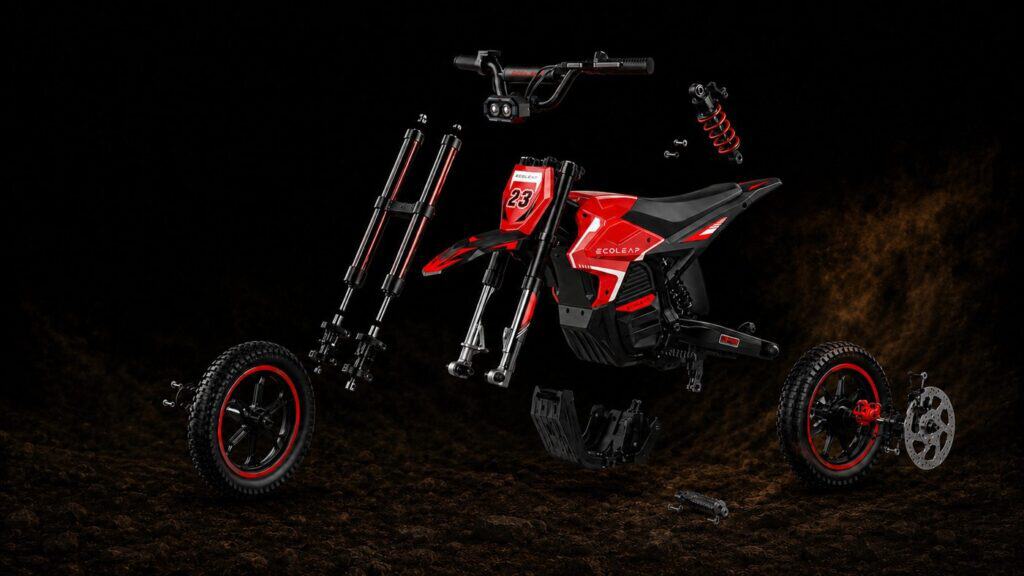
K2 component illustration. Manufacturer image: ECOLEAP.
The K2 has a 36V 7.8Ah lithium-ion battery.
That gives it a nominal capacity of:
36V × 7.8Ah = 280.8Wh
ECOLEAP advertises up to 18 miles of riding range per charge.
That’s a useful headline figure, but it shouldn’t be interpreted as a guaranteed result.
What Affects Real-World Range?
Several factors will influence how far the K2 travels:
- Riding at 20 mph instead of 10 mph
- Rider weight
- Hills and uneven terrain
- Frequent acceleration and stopping
- Grass, loose dirt, and soft surfaces
- Cold weather and battery age
The 18-mile claim corresponds to about 15.6 Wh per mile.
That is mathematically plausible under favorable conditions, but it doesn’t reflect what the bike will achieve during demanding off-road riding.
Until independent range testing is available, I would treat 18 miles as an optimistic upper-end figure.
Charging Time and Battery Removal
ECOLEAP lists a charging time of approximately 5–6 hours using the included 42V 1.5A charger.
The battery is removable for servicing or replacement, although the manufacturer recommends normal charging while it remains installed.
This is a welcome feature because batteries are consumable components.
Replacing a worn battery can extend the bike’s useful life.
Parents should use the supplied charger or a manufacturer-approved replacement, follow the manual’s charging instructions, and avoid leaving the bike charging unattended.
Suspension Performance: Full Suspension at an Affordable Price
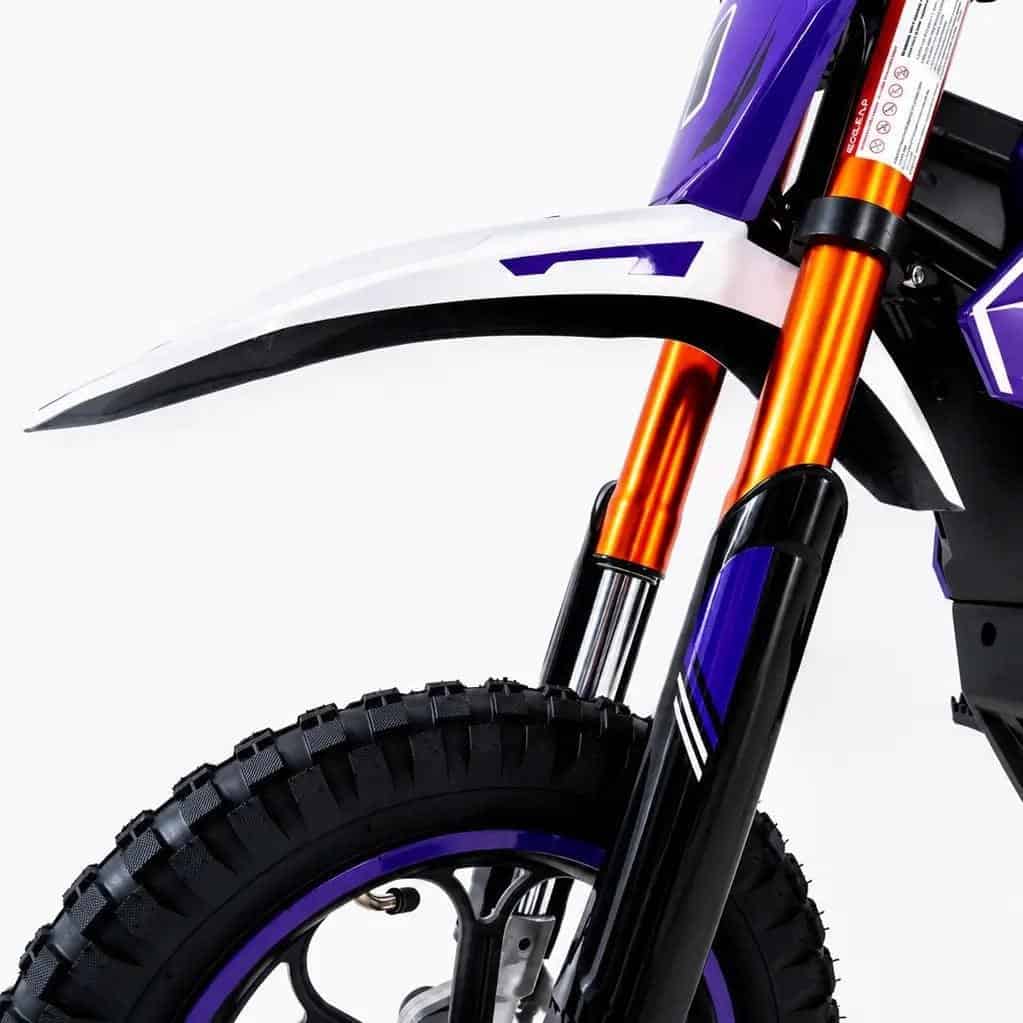
Front suspension detail. Manufacturer image: ECOLEAP.
The ECOLEAP K2 features suspension at both ends, which is an appealing feature for a children’s electric dirt bike.
The front uses an inverted hydraulic or oil-spring fork, while the rear uses a spring shock absorber.
Together, these components reduce the impact of bumps and uneven surfaces.
Front Suspension
The front fork should help absorb smaller impacts encountered on gravel, compact dirt, and uneven grass.
This matters because a rigid front end can transfer bumps directly into the handlebars.
For a developing rider, reducing that harshness may make the bike more comfortable and easier to manage.
However, ECOLEAP doesn’t clearly publish suspension travel or detailed damping-adjustment specifications.
Without those measurements or hands-on testing, it’s difficult to judge how well the fork performs over larger bumps.
Rear Suspension
The rear spring shock adds another layer of comfort.
It should help reduce impacts transmitted through the seat when riding across rougher ground.
For a bike intended primarily for recreational use, this feature is useful.
However, parents shouldn’t confuse the K2’s suspension with the more sophisticated systems found on dedicated motocross motorcycles.
It’s better viewed as a way to improve comfort on light off-road terrain rather than equipment designed for jumps or aggressive trail riding.
Braking: The Biggest Compromise?
The K2 uses a hand-operated rear mechanical disc brake.
A disc brake is a reasonable choice for a small electric dirt bike, offering a serviceable friction-braking system.
However, the K2 has only one listed brake, located at the rear wheel.
This is one of the areas I would examine most carefully before buying.
Why the Rear-Only Brake Matters
During braking, weight transfers toward the front of a motorcycle.
A well-designed front brake can provide a substantial portion of the available stopping force, especially on firm surfaces.
The K2’s rear-only setup limits braking to the traction available at the rear tire.
That doesn’t automatically make the system inadequate for its intended use, but it does mean braking performance deserves particular attention.
The mechanical system may also require periodic cable adjustment and brake-pad maintenance.
For parents, I would recommend checking that the child can comfortably reach and operate the brake lever, then practicing repeated controlled stops at the lowest speed.
I would also like to see independent stopping-distance measurements before making any strong claims about the K2’s braking capability.
Off-Road Performance: Where Can Kids Ride the K2?
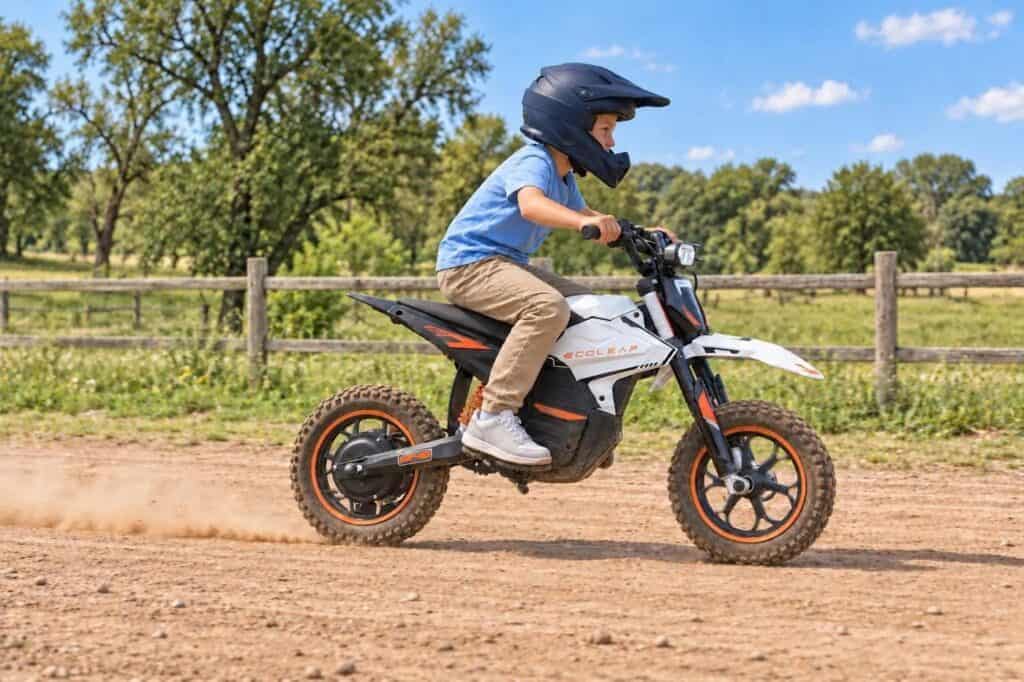
K2 off-road promotional image. Source: ECOLEAP.
ECOLEAP markets the K2 for recreational use on dirt trails, grass, gravel, and similar light off-road surfaces.
Its 12 × 2.75-inch pneumatic tires should offer more compliance and traction than the hard plastic wheels found on many inexpensive ride-on toys.
The full suspension also makes sense for these environments.
Grass and Backyards
For families with a suitable private riding area, the K2 could be a practical option.
Its compact dimensions make it easier to accommodate than a full-size dirt bike, while its electric drivetrain eliminates engine noise and exhaust emissions at the point of use.
However, wet grass can significantly reduce traction, and uneven lawns can hide obstacles.
Gravel and Dirt Trails
The K2’s tires and suspension are well matched on paper to relatively smooth dirt and gravel surfaces.
The bike should be more appropriate for this type of riding than for aggressive motocross terrain.
Loose gravel, steep slopes, and deep ruts introduce additional risks, especially with the rear-only brake.
What About Hills?
The 400W sustained motor may handle modest inclines, but ECOLEAP doesn’t provide enough verified information to establish reliable hill-climbing limits.
Steeper climbs will increase motor demand and battery consumption.
I would avoid making purchasing decisions based on assumed climbing performance until independent tests are available.
The manufacturer specifically states that the K2 is not intended for extreme motocross tracks or public-road use.
Comfort and Ergonomics: Designed for Smaller Riders
The ECOLEAP K2 has a 20.67-inch seat height, wide footrests, and a padded motorcycle-style saddle.
These features are intended to provide a stable riding position without forcing children to reach for conventional bicycle pedals.
The long seat also allows some flexibility in positioning, although proper handlebar reach and foot placement remain important.
Is the K2 Suitable for a Four-Year-Old?
ECOLEAP advertises the K2 for ages 4–8, but age alone is not a reliable measure of readiness.
Some four-year-olds may already have strong balance-bike skills, while older children may still be developing coordination and braking confidence.
I would prioritize three things: whether the child can balance confidently, whether they can operate the controls reliably, and whether they can manage the bike’s weight when stopping.
A younger beginner may be better served by a lighter, slower electric balance bike.
Controls, Display, and Everyday Features
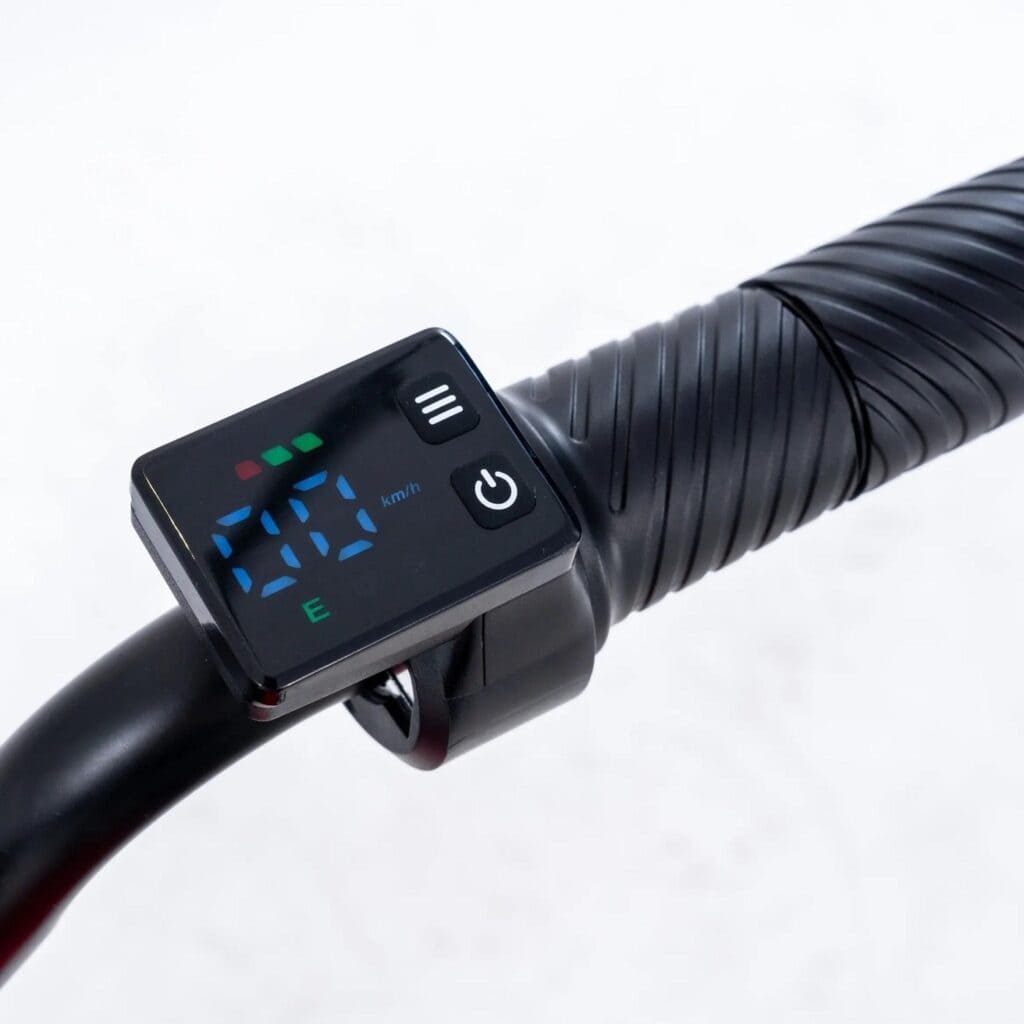
Handlebar display detail. Manufacturer image: ECOLEAP.
The K2 includes several features that improve everyday usability.
Its LED display shows speed, remaining battery level, and the selected riding mode.
This is particularly useful for parents supervising practice sessions because it makes the bike’s current setting visible.
ECOLEAP rates the dual LED headlight at 100 lux.
While this adds visibility, I wouldn’t use it to encourage children to ride after dark. Riding in daylight in a controlled environment remains preferable.
The K2 also has an IP54 dust-and-splash-resistance rating. This means it resists limited dust ingress and splashing water, but it is not waterproof.
Avoid submerging the bike, pressure washing its electrical components, or leaving it exposed to prolonged heavy rain.
Assembly and Maintenance: Is the K2 Parent-Friendly?
According to ECOLEAP, the K2 arrives about 85–90% assembled, and final assembly typically takes 15–30 minutes.
The package includes the charger, user manual, and several assembly tools.
Before the first ride, parents should inspect the handlebars, wheel fasteners, brake operation, tire pressure, suspension components, and electrical connections.
The chainless drivetrain is a significant maintenance advantage.
Unlike chain-driven electric dirt bikes, chainless models don’t require chain tension checks or sprocket lubrication.
Routine maintenance still includes brake adjustments, tire inspections, fastener checks, and battery care.
ECOLEAP also advertises U.S.-based replacement parts support, although availability may depend on the specific component.
Safety and Certifications: What Parents Should Know
ECOLEAP reports UL 2271 certification for the battery and UL 2272 certification for the electrical system, along with CPC compliance and ASTM F963 testing.
These claims are encouraging, but I would verify the applicable certification documentation and exact model coverage before treating them as independently confirmed.
Electrical certifications do not guarantee safe handling or crash protection.
Children should wear a properly fitted helmet appropriate for motorized off-road riding, along with gloves, eye protection, sturdy footwear, and knee and elbow protection.
Adult supervision is essential, especially while learning throttle and braking control.
Because the K2 has no pedals and can reach 20 mph, it should be treated as a motorized off-road vehicle rather than an ordinary pedal-assist bicycle. Public-road, sidewalk, and trail access rules vary by jurisdiction.
What I Like About the ECOLEAP K2
Three selectable speed settings
The 10, 15, and 20 mph modes provide flexibility as a rider develops confidence and experience.
Low-maintenance chainless drivetrain
No chain lubrication, chain adjustment, or dropped chains to worry about.
Front and rear suspension
A welcome addition for comfort on light off-road terrain.
Removable lithium battery
The 280.8Wh battery offers useful capacity on paper and can be replaced when needed.
Genuine mini dirt bike design
Steel construction, pneumatic tires, footrests, and a motorcycle-style seat distinguish it from basic ride-on toys.
What Could Be Improved?
Rear-only braking
A separate front brake would add another braking option, especially as riding speeds increase.
Relatively heavy for smaller children
At nearly 42 pounds, the K2 could be difficult for some younger riders to maneuver after a fall.
10 mph minimum speed setting
Even the lowest mode may be too fast for a child with no previous riding experience.
Limited independent performance data
Advertised range, hill-climbing capability, braking distance, and suspension performance still need independent verification.
Inconsistent peak motor specifications
ECOLEAP’s materials list both 750W and 850W peak ratings, so it’s worth confirming the exact version being sold.
Who Should Buy the ECOLEAP K2?
The ECOLEAP K2 makes the most sense for families with children who already know how to balance on two wheels and are ready to learn powered riding.
It’s particularly appealing if you have access to a suitable private riding area or permitted off-road trails.
Parents who value simple maintenance may also appreciate the chainless hub motor, while the selectable speed settings provide some flexibility as skills improve.
The K2 could be a good choice for a child moving beyond a traditional balance bike who is physically capable of managing a heavier electric machine.
Who Should Skip It?
Look elsewhere if you’re buying a child’s first two-wheeled vehicle and they haven’t developed basic balance skills.
The K2 also isn’t ideal for families who need a street-legal electric bicycle, since it lacks pedals and is marketed for off-road use.
Older or taller children may find the compact frame restrictive, regardless of its generous advertised 176-pound maximum load.
If your priority is advanced off-road performance, more sophisticated brakes, or jump-ready suspension, the K2 isn’t designed for that category.
ECOLEAP K2 vs. Basic Kids’ Electric Ride-On Bikes
| Feature | ECOLEAP K2 | Typical basic ride-on |
| Top speed | Up to 20 mph | Often 2–6 mph |
| Motor | 400W sustained | Varies; often lower power |
| Suspension | Front and rear | Often limited or none |
| Tires | Pneumatic rubber | Often plastic or hard rubber |
| Drivetrain | Chainless hub motor | Varies |
| Braking | Rear disc brake | Often motor or basic mechanical braking |
| Learning curve | Higher | Generally lower |
| Best use | Supervised off-road riding | Low-speed play |
Basic ride-on specifications vary considerably by model. This comparison illustrates broad product-category differences rather than a specific competitor.
The K2 is substantially more capable than many entry-level electric ride-on toys, but that additional capability comes with greater responsibility.
For a child who has outgrown a slow ride-on and developed solid balance skills, the K2 offers a more engaging progression.
For a complete beginner, however, a slower and lighter machine may be the better investment.
Is the ECOLEAP K2 Worth the Money?
ECOLEAP’s official website listed the K2 at about $499 when we researched it, though pricing and promotions can change.
At around that price, the combination of a brushless hub motor, lithium battery, full suspension, pneumatic tires, and steel frame looks competitive on paper.
Its chainless design could also reduce routine maintenance compared with similarly priced chain-driven alternatives.
However, value isn’t just about how many features you get for the money.
A children’s electric dirt bike needs to fit its rider properly, offer predictable control, and have dependable replacement parts and support.
Before purchasing, I’d want confirmation of the current warranty terms, availability of replacement brake components and the battery, and the exact specifications of the Amazon model.
If those details check out, the K2 presents a compelling package for families seeking a recreational mini electric dirt bike.
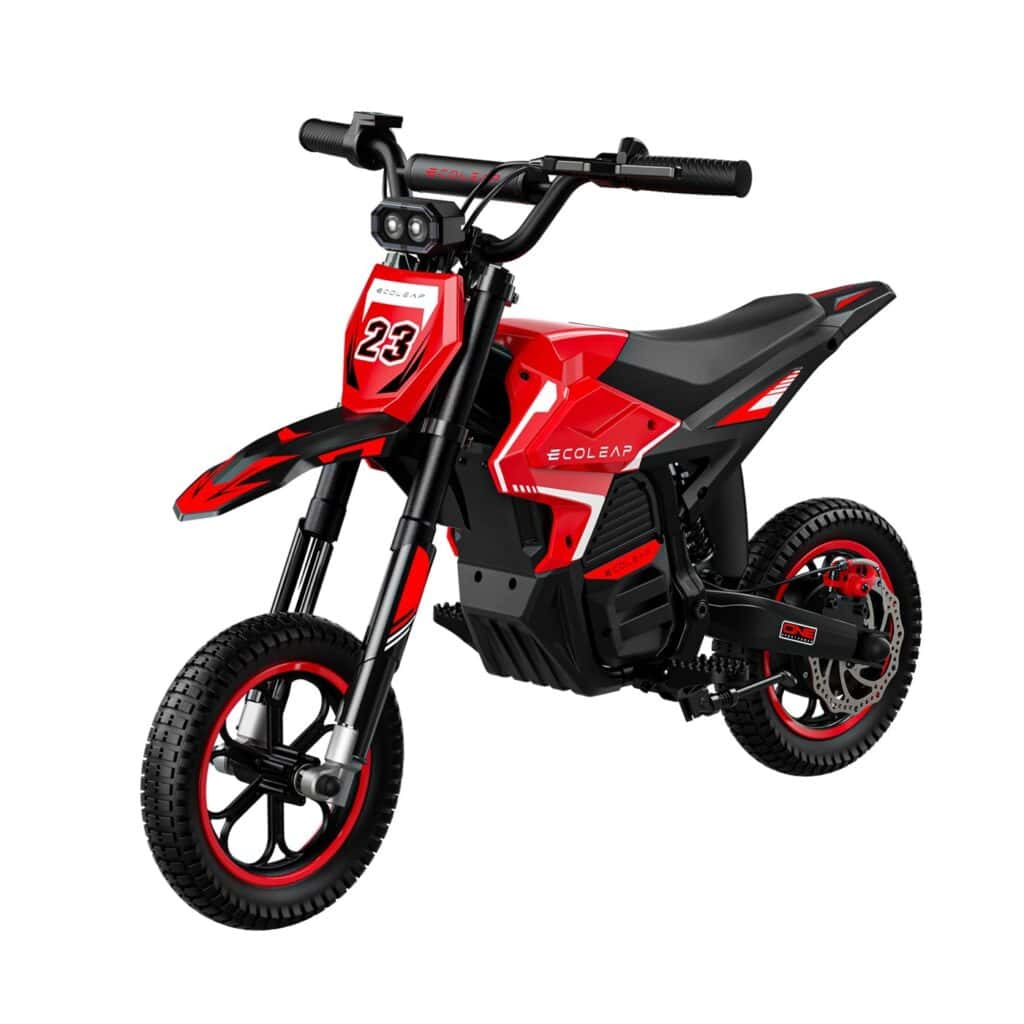
ECOLEAP K2 product view. Manufacturer image: ECOLEAP.
ECOLEAP K2 Kids Electric Dirt Bike
36V battery · Three speed modes · Full suspension
Compare the latest Amazon offer
Frequently Asked Questions
How fast does the ECOLEAP K2 go?
The ECOLEAP K2 has three advertised speed settings: 10, 15, and 20 mph. Actual speed may vary with rider weight, terrain, battery charge, and conditions.
What age is the ECOLEAP K2 designed for?
ECOLEAP recommends ages 4–8. However, rider height, balance, physical strength, and riding experience matter more than age alone.
Does the ECOLEAP K2 have pedals?
No. The K2 is a throttle-powered electric dirt bike with footrests rather than pedals. Don’t confuse it with a conventional pedal-assist e-bike.
How long does the battery last?
ECOLEAP advertises up to 18 miles per charge. Real-world range depends on riding conditions, and this review has not independently verified it.
Does the ECOLEAP K2 have a chain?
No. It uses a brushless hub motor that drives the wheel without a traditional chain-and-sprocket system.
Can the ECOLEAP K2 ride on grass?
The manufacturer lists grass, dirt, and gravel among its intended riding surfaces. Traction and performance will depend on ground conditions, particularly on wet or uneven grass.
Is the ECOLEAP K2 waterproof?
No. The bike carries an advertised IP54 rating, meaning it is designed to withstand limited dust exposure and splashes, not submersion or prolonged heavy rain.
Can you add training wheels to the ECOLEAP K2?
No. According to ECOLEAP, the K2 is not compatible with training wheels.
How long does the ECOLEAP K2 take to charge?
The advertised charging time is approximately 5–6 hours using the included charger.
Can adults ride the ECOLEAP K2?
Although its maximum advertised load is 176 pounds, the K2 is dimensioned for children. Its compact frame and low seat make it unsuitable for most adult riders.
Final Verdict: A Promising Mini Electric Dirt Bike With Some Important Trade-Offs
The ECOLEAP K2 offers an appealing combination of performance, practicality, and relatively low maintenance for a children’s electric dirt bike.
Its 400W sustained brushless motor, three selectable speed modes, full suspension, and 12-inch pneumatic tires make it a substantial step beyond basic electric ride-on toys.
The chainless drivetrain is particularly attractive from a maintenance perspective, while the removable lithium battery adds potential long-term serviceability.
But the K2 isn’t without compromises.
Its 42-pound weight may be challenging for smaller children, its rear-only mechanical disc brake deserves attention, and the 10 mph minimum speed setting isn’t necessarily appropriate for complete beginners.
I also wouldn’t assume the advertised 18-mile range represents typical off-road performance without independent testing.
The bottom line: The ECOLEAP K2 looks like a worthwhile option for children with strong balance skills who are ready to progress to supervised electric dirt bike riding. For those riders, its adjustable speed, suspension, and low-maintenance construction offer real appeal.
For first-time riders, though, I’d prioritize a lighter, slower machine before moving up to something capable of 20 mph.
Ready to Compare the ECOLEAP K2?
Check the latest Amazon pricing, customer reviews, color availability, and seller details.
Recommended SEO settings for eBikeSavvy
| Field | Recommendation |
| SEO title | ECOLEAP K2 Review: Is This Kids Electric Dirt Bike Worth It? |
| URL slug | ecoleap-k2-kids-electric-dirt-bike-review |
| Primary keyword | ECOLEAP K2 review |
| Secondary keywords | ECOLEAP K2 electric dirt bike, kids electric dirt bike, 20 mph kids electric bike, ECOLEAP K2 specs |
| Category | Kids Electric Dirt Bike Reviews |
| Schema | Product + Review (only with accurate attribution and no fabricated testing or ratings) |
Meta description:
Our ECOLEAP K2 review covers its 20 mph top speed, 36V battery, full suspension, braking, safety, and value. Is it right for your child?
Before publishing on eBikeSavvy
I’d make three editorial improvements before publishing this article.
First, use authentic ECOLEAP product photography that you have permission to publish, ideally showing the bike’s suspension, rear brake, controls, and a correctly equipped rider.
Second, add an Amazon Associates tracking ID to the purchase links and place a clear affiliate disclosure near the beginning of the article. Also verify the current Amazon variant, especially because the manufacturer’s peak motor figures are inconsistent.
Third, distinguish this research-based review from a hands-on review. That is especially important when building eBikeSavvy into a credible affiliate publication. You can publish useful specification-based buying analysis now, then strengthen the article with original riding tests, braking observations, battery results, and photographs later.
For eBikeSavvy’s monetization strategy, this article should eventually link internally to a Best Electric Dirt Bikes for Kids buying guide, a Kids Electric Dirt Bike Size Guide, and relevant competitor reviews. Those supporting pages can help turn individual product searches into a more useful shopping journey.
Document preparation note: The chat’s nonfunctional image placeholders and unresolved citation markers have not been carried into this document. Product specifications, certification claims, and the quoted price should be verified against accessible primary sources before publication. This transfer preserves the review draft; it is not a new fact-check.
Image sourcing note: Manufacturer product and promotional images have been added with source links. These are not eBikeSavvy hands-on test photographs. Confirm permission to reuse the images before website publication. Adding images does not independently verify the specifications, certification claims, or pricing in this draft.